
Dripos Shop Sustainably Spotlight: Torque Coffee

One of the most influential and challenging decisions every roaster makes is around where to source coffee beans. By establishing and maintaining relationships with producers that align with your values around labor, farming, and your environmental footprint, it’s easy to sell coffee that tastes good and feels good to source.
As part of our Shop Sustainability Spotlights, we’ll be tapping café partners and roasters that prioritize different aspects of sustainability in their day-to-day operations.
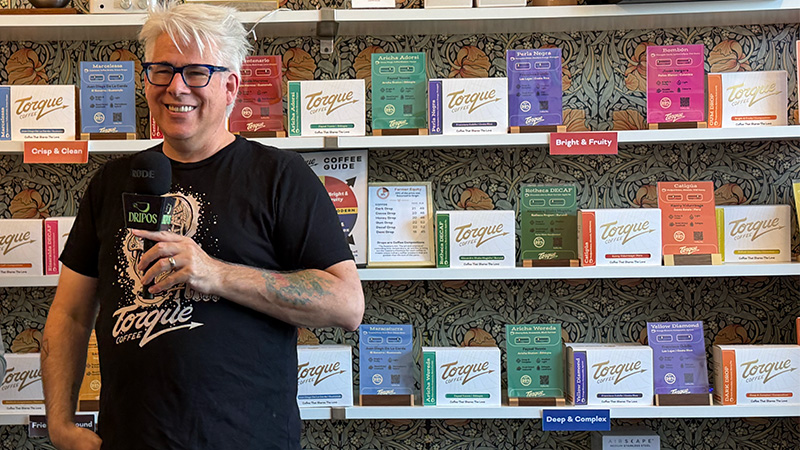
First up, we chatted with Andy Newbom of Torque Coffee in San Diego, California, where at least 20% of each coffee’s retail price stays within the country of origin. By implementing an approach they call Proportional Pricing, the Torque team ensures that their producers in Costa Rica, Ethiopia, Colombia, Mexico, and Guatemala are compensated transparently and fairly for their coffee.
In addition to the Proportional Pricing approach, what’s a top-level overview of what makes your sourcing philosophy unique?
We prioritize buying more coffees from fewer producers in order to increase our impact. So instead of buying a smattering of coffees from all over, we buy a second or third coffee from the same producer to get more money into their hands.
What are some of the core challenges to sourcing coffee sustainably?
The market friction of finding and receiving great coffee is functionally zero now. But climate change and global inequality are increasingly making that frictionless process irrelevant.
It’s so easy to source amazing coffee, and anyone who says otherwise is lying. You can DHL green coffee from origin to your roastery (if the producer and exporter are financially able to) and since everyone has a roaster, it’s never been easier to turn coffee brown.

How do you build strong relationships with the producers you source from?
It’s very easy for coffee roasters to think of relationships with producers as a one-way street. But in our experience, the best thing coffee roasters can do to build and strengthen relationships with coffee producers is to treat them like valuable vendors who run businesses, and as the most important vendor of their business.
Ultimately, you need to build a relationship on doing business together as equals. It’s not a charity nor is it “giving back.” As you build that foundation, it's easy to find out more about their interests, family, and other great things to lead to a long-term, healthy vendor relationship. Once you find great coffee people, stick with them through thick and thin, good and bad. Go deep not wide — without scale, your business can’t have the impact you want it to have on the supply chain.

What would you say are some of the main misconceptions about how coffee is sourced?
Everyone nowadays thinks that because they can get the name of the producer from the importer, they do direct trade. Buying great coffee is ridiculously easy now, you can buy excellence from everywhere — buying and roasting great coffee is not a differentiator in 2026.
But sourcing great coffee, treating producers like businesses, ensuring better producer equity in the retail price, and empowering producers through increased depth of purchases is very different still. In an age when "everyone roasts", the act of turning green coffee from green to brown isn’t difficult and doesn't move the needle.


.jpg)