Coffee Prices Are Falling: Should Cafes Cut Menu Prices?

TLDR: Arabica futures are down about 27% from a year ago, but that does not mean your roaster invoice drops 27%, and it does not mean you should cut menu prices. Check what your roaster is actually charging, do the per-cup math, and only then decide. For most shops the right move is to hold prices and keep the savings.
Dripos works with about 3% of US coffee shops and has processed over $1B in coffee shop payments, so we see a lot of cafes deciding this exact thing right now. Here is how to think about it.
What actually happened to coffee prices
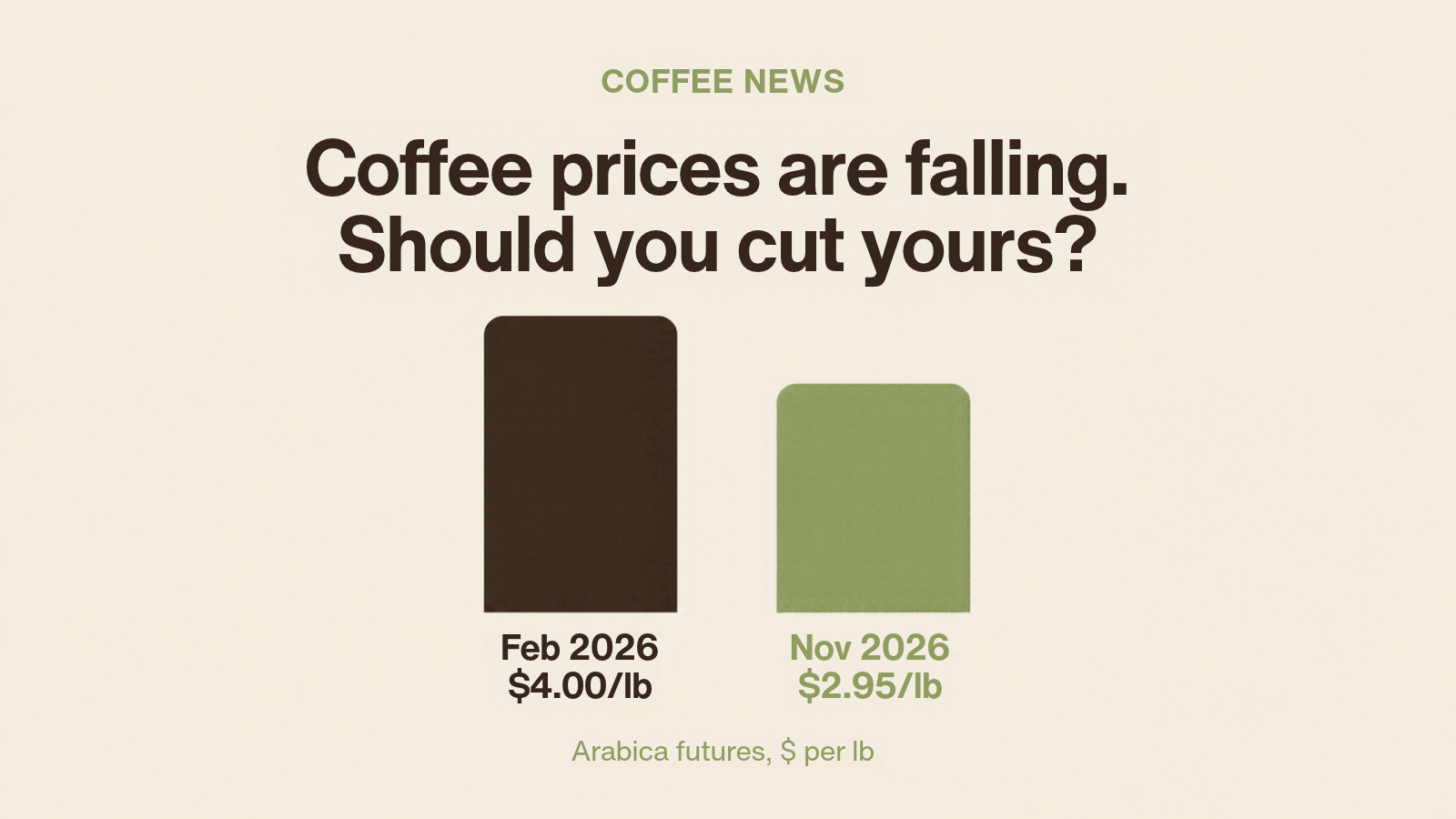
Arabica futures topped $4.00 a pound in February 2026, up about 60% from roughly $2.50 a year earlier, according to QSR Pro. As of November 2, 2026, Trading Economics has arabica at about $2.95 a pound, down roughly 27% from a year ago.
A few things pushed it down:
- Brazil is shipping a lot of coffee. Exports hit about 3.30 million bags by October 22, up 43% from last year, per Cecafé.
- The Brazilian real weakened after the presidential election, which makes selling abroad more attractive for growers.
- Most coffee imports are no longer hit by the reciprocal tariffs, and the separate Brazil tariff was eliminated for goods entered on or after mid-November 2025, according to Dilworth Coffee.
It is not all calm. Certified arabica stocks sit near a 27-year low, around 240,000 bags, and weather in Brazil can still change the picture fast. The price jumped more than 2.5% on November 2 alone.
Why your invoice will not drop 27%
Futures are the price of unroasted green coffee for future delivery. Your roaster pays something else: green coffee they bought months ago, plus roasting labor, gas, packaging, freight, and margin. Only part of your per-pound price is the bean.
Tariffs add a lag too. They are collected when coffee clears customs, so beans imported under the old duties are still working their way through roasters' inventory. Dilworth says plainly not to expect immediate drops and to ask your roaster when relief will reach your pricing.
Wholesale roasted coffee runs about $10 to $14 a pound for most cafes, per Bellwether. That is a wide range, and it is the number that matters to you, not the futures ticker.
Do the per-cup math before you touch the menu
Say you pay $12 a pound. A pound is about 454 grams. A double shot uses roughly 18 grams, so a pound gets you around 25 doubles. That is about $0.48 of coffee per double.
Now say your roaster passes through a 10% cut. You save about $0.05 per double.
If you pull 400 espresso drinks a day, that is about $19 a day, or roughly $7,000 a year. That is real money. It is also about a nickel a drink, and no customer will notice a nickel come off a $5 latte.
Compare that with what happened on the way up. QSR Pro estimates bean cost per cup rose $0.10 to $0.15 for drip and $0.20 to $0.30 for espresso drinks at the peak. If you raised prices then, you probably did not raise them enough to cover the full jump. Falling costs are your chance to get back to your target margin.
Why holding prices is usually right
Food economist Mike von Massow told BNN Bloomberg that grocery coffee should come down over the next few months, but that we are probably not going to recover the whole 30% increase. He expects cafe menu prices to change little, since many shops absorbed higher costs along the way.
That matches how most shops behave. Customers remember a price increase. They almost never notice a price that stays the same.
Here is the rule we would use:
- Figure out where you stand. Pull your last six months of coffee and milk invoices and calculate your cost of goods sold (COGS) percentage. The latte pricing guide walks through the math.
- Compare it to your target. A common range is 25% to 35%. If you are above it, falling costs are catching you up, not giving you room.
- Cut only if you are well under target and a competitor is pricing below you. Otherwise hold.
If you are already at or under target, you have choices that beat a price cut: put the money into labor (the hardest line to cover), fix a drink that was underpriced, or build a cushion for the next spike.
Ask your roaster these questions
You do not need to be aggressive about this. You just need to ask.
- When did you last change your wholesale price, and what was the change?
- Are you still working through coffee bought at higher prices?
- Do you offer a lower price for a fixed volume or a longer commitment?
- If green prices rise again, how much notice do I get?
A good roaster will answer all four without fuss. If yours does not, that tells you something.
Check your own numbers, not the headlines
The headline number is arabica futures. The number that decides whether you make money is your cost per drink, by drink, against what you charge. Those can move in opposite directions. Milk, labor, rent, and cup costs do not follow coffee futures.
Your POS should do this arithmetic for you. Dripos has an inventory and COGS report built for this. Here is the reports overview if you want to see what is available.
What we are watching
Three things will tell us whether this drop lasts: Brazil's harvest pace and the real, the certified stock level (very low, so deliveries could get squeezy), and whether more tariff changes land. We will keep an eye on it and update this post if something big moves.
For now, check your invoices, run the numbers, ask your roaster the four questions, and keep your prices steady unless the math says otherwise.
Sources: Trading Economics, QSR Pro, Dilworth Coffee, Bellwether Coffee, BNN Bloomberg.